


QURAN IJAZAH & CONNECTED SANAD
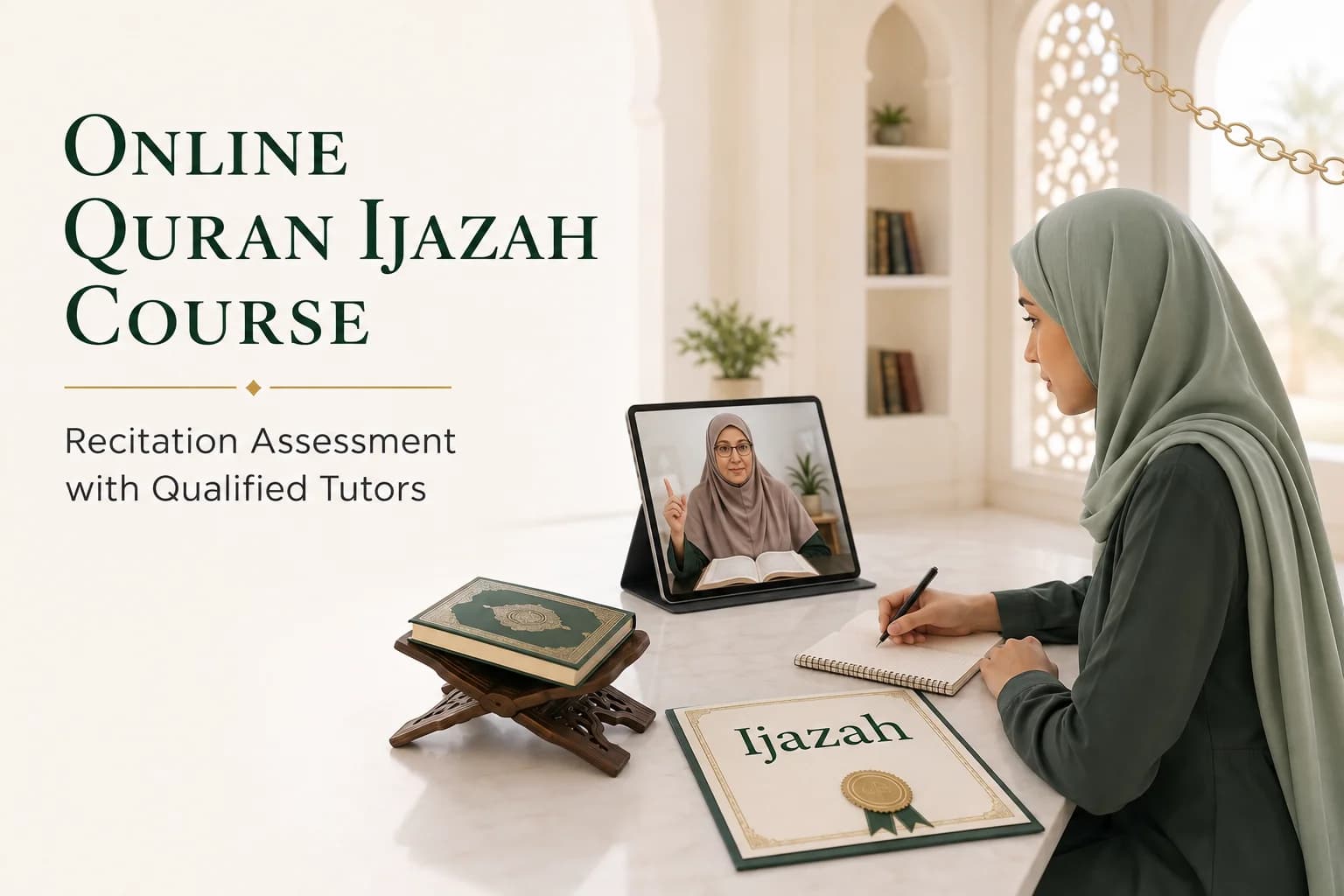
Online Quran Ijazah Course
Prepare for a Quran Ijazah, a traditional license backed by a connected Sanad (chain of transmission), in Quran recitation (Tilawah), Tajweed, or memorization (Hifz). Study one-to-one online with a certified scholar who corrects every detail and evaluates your readiness. An Ijazah is earned, not guaranteed by enrollment.
- Ijazah pathways: recitation, Tajweed or Hifz
- One-to-one live lessons
- Connected Sanad, granted only on meeting the standard
- Free Trial - No Card Required
What Is a Quran Ijazah?
An Ijazah (Arabic: ijāzah, “permission” or “license”) is a traditional certification in the Quranic sciences. It confirms that a student has recited the Quran, or a defined portion of it, to a qualified teacher with the required accuracy, and that the teacher authorizes the student to recite and to transmit what they have mastered to others.
Unlike a simple attendance record, an Ijazah is a scholarly license: it is granted only after the teacher is satisfied that the recitation meets the standard, and it carries a connected chain of transmission (Sanad), which is what gives it its weight. The best-known Ijazah is in Quran recitation with correct Tajweed, usually in the riwayah of Hafs ‘an ‘Asim.
What Is a Sanad (Chain of Transmission)?
A Sanad (or Quran Sanad) is the chain of transmission: the unbroken line of teachers that connects a reciter, teacher by teacher, back through the generations to the Prophet Muhammad (peace be upon him), who received the Quran from the Angel Jibril. When an authorized teacher grants an Ijazah, the student joins this chain and can, in turn, transmit it forward, which is why a connected Quran Sanad is so highly valued.
Connected transmission (isnad) has always been central to preserving Islamic knowledge. As the early scholar Abdullah ibn al-Mubarak said, “The isnad is part of the religion; were it not for the isnad, whoever wished could say whatever he wished” (reported by Imam Muslim in the introduction to his Ṣaḥīḥ). A genuine Ijazah is valuable precisely because it documents this living chain, rather than merely asserting a level of skill.
Ijazah vs. a Course Certificate
It is important not to confuse the two:
- A course-completion certificate records that you attended or finished a course. It is issued for participation and says nothing about a chain of transmission.
- An Ijazah is a scholarly license with a connected Sanad. It is granted only when an authorized teacher is satisfied that your recitation meets the required standard, and it authorizes you to transmit and teach what you have mastered.
In short: a certificate marks completion; an Ijazah marks verified mastery within a chain. For general study rather than certification, see our Quran reading with Tajweed and advanced Tajweed courses.
Ijazah Pathways: Recitation, Tajweed & Hifz
An Ijazah can be pursued along different pathways, depending on your goal:
- Ijazah in Quran Recitation (Tilawah): reciting the entire Quran from the Mushaf with accurate Tajweed, to the standard set by an authorized teacher.
- Ijazah in Tajweed: demonstrating command of the rules of recitation (Makharij, Sifat, Madd and more), often alongside classical texts such as al-Jazariyyah and Tuhfat al-Atfal. A Tajweed Ijazah suits reciters focused on mastering the rules.
- Ijazah in Quran Memorization (Hifz): reciting the entire Quran from memory, accurately and with Tajweed.
Most Ijazah programs work in the riwayah of Hafs ‘an ‘Asim, among the most widely recited riwayat in the Muslim world today. To go further into the different canonical readings, see our dedicated Ten Qira’at course.
Who Can Join? Prerequisites
An Ijazah is an advanced goal, so there are real prerequisites:
- You should already recite the Quran fluently and accurately with correct Tajweed.
- For an Ijazah in Hifz, you must have completed memorization of the whole Quran (or be very close), since the final evaluation is recitation from memory.
- An Ijazah in Tajweed or recitation requires a strong command of the rules and consistent, accurate reading.
Complete beginners are not yet ready for an Ijazah. If you are still building your foundations, start with our Noorani Qaida, Quran reading with Tajweed and Hifz courses. A short recitation or memorization assessment at the start confirms your level and the right starting point.
How the Ijazah Program Works: Three Stages
It helps to see the Ijazah as three distinct stages. Enrolling does not, by itself, produce an Ijazah. Each stage must be met in turn.
- Enrollment in the preparation program. You join one-to-one lessons and begin structured study and correction. This is the starting point, not the certificate.
- Meeting the required standard. You complete the required recitation or memorization assessment to the standard set by the authorized teacher. Any errors identified during the assessment must be corrected before the teacher decides whether to grant the Ijazah. This stage is the real work, and its length depends entirely on your current proficiency.
- The authorized teacher’s decision to grant the Ijazah. Only when the teacher is satisfied that you have met the standard do they grant the Ijazah with its connected Sanad. This decision rests with the authorized teacher and cannot be guaranteed in advance.
Throughout, learning is by talaqqi: direct, live recitation to the teacher with immediate correction, the way the Quran has always been transmitted. Regular assessments track your accuracy, and a final evaluation confirms readiness before any Ijazah is issued.
Why Choose QuranHost
Why Prepare for Your Ijazah with QuranHost
Ijazah preparation is demanding and deeply personal. Here is how our online program supports serious students on that path.
One-to-One Live Lessons
Every session is private, so your teacher hears every letter and corrects in real time, essential for reaching the Ijazah standard.
Recitation Assessment First
An honest assessment at the start sets a realistic pathway and starting point before you commit.
Certified Scholars & Al-Azhar Graduates
Lessons are guided by certified scholars, including Al-Azhar graduates and native Arab teachers from Egypt and other Arab countries, who hold their own Ijazah with a connected sanad.
Male & Female Teachers
Available for men, women and children, subject to language and scheduling availability.
The Talaqqi Method
You receive the recitation the way it has always been transmitted, directly, teacher to student, with careful correction.
Flexible Scheduling
Study around work, study and prayer, across time zones, with a schedule you can keep consistently.
Getting Started
How to Get Started
Begin your Ijazah preparation in three simple steps.
Book a Free Trial & Assessment
Recite for your teacher, who assesses your Tajweed and recommends a suitable pathway and starting point.
Study & Correct
Work through structured, one-to-one correction until your recitation is accurate and consistent, the way the Quran is transmitted.
Final Evaluation
When you meet the standard, your teacher conducts the final evaluation and decides on the Ijazah. See our plans and pricing.
It only takes a minute to book, and there is no obligation.
Who Issues the Ijazah Certificate?
Each Ijazah is issued only by a tutor who holds the relevant Ijazah and has authorization to teach and transmit that specific recitation or memorization pathway. Holding an Ijazah and being authorized to grant one are not automatically the same, and academic graduation alone does not confer that authority. The certificate typically records the pathway (recitation, Tajweed or Hifz), the riwayah (such as Hafs ‘an ‘Asim), and the chain of transmission (Sanad).
At QuranHost, the Ijazah pathway is taught by certified scholars, including Al-Azhar graduates and native Arab teachers from Egypt and other Arab countries, who hold a valid Ijazah with a connected Sanad. Each Ijazah, however, is granted only by a tutor authorized to transmit that specific pathway; an Al-Azhar degree by itself is a qualification, not authorization to issue an Ijazah.
QuranHost has qualified Quran teachers, including tutors who hold a valid Ijazah with a connected Sanad. For an Ijazah pathway, students are assigned to an appropriately authorized tutor based on the required recitation, memorization track, language, and availability. You can learn more about our online Quran teachers and their teaching experience.
Two points of honesty matter here:
- Admission does not guarantee an Ijazah. Enrolling in the preparation program is the first step, not the outcome. The Ijazah is granted only on meeting the standard, at the authorized teacher’s discretion.
- Completion time depends on you. There is no fixed timeframe. How long it takes depends on your existing proficiency, your Hifz (for the memorization pathway), your lesson frequency and consistent practice. Be cautious of any promise of a guaranteed Ijazah or a fixed completion date.
Have questions about your pathway? Contact us with your goals.
Related Courses
Build the foundations for your Ijazah, or continue your Quran studies, with our other one-to-one online courses:
- Noorani Qaida: for beginners learning to read Quranic Arabic.
- Quran Reading with Tajweed: fluent, accurate recitation.
- Advanced Tajweed Course: the rules in depth.
- Quran Memorization (Hifz): required for the Hifz Ijazah.
- Ten Qira’at Course: the ten canonical readings.
- Tafseer-ul-Quran: understanding the meanings.
Begin Your Quran Ijazah Journey
Book a free trial and let an authorized teacher assess your recitation and map a realistic path to your Ijazah.